Work / A research-inspired starling flock in Rust and wgpu, moving a terminal simulation into GPU compute shaders.Starlings at dusk on the GPU
Context
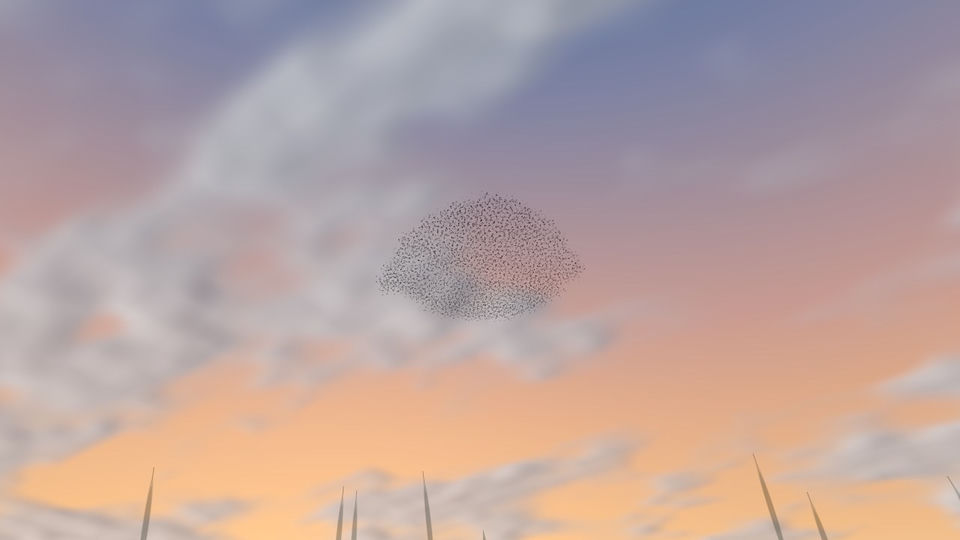
I started with murmuration, a starling flock drawn in a terminal. This version moves the simulation to GPU compute shaders in Rust and wgpu, with individual birds banking against a procedural dusk sky.
I had worked on the show software for Murmur years earlier. This personal project returns to flocking through a different medium.
The problem
A naive neighbour search has a quadratic cost. Moving the whole flock between CPU and GPU each frame adds transfer overhead too. I wanted to keep neighbour searches, state updates and rendering on one GPU, while retaining a CPU reference to check the model's behaviour.
The flock follows local rules inspired by StarDisplay and starling field studies: adaptive neighbour attention, banked flight and attraction towards the roost. The resulting motion is still a work in progress, especially the complex folding seen in reference footage.
What I did
- Moved the neighbour search onto a sorted uniform grid in GPU memory.
- Shared the bird-state buffer between compute and rendering, avoiding a full flock readback during interactive playback.
- Rendered birds at different levels of detail, with wingbeats, banking and accumulated darkness where their silhouettes overlap.
- Compared GPU and CPU flock statistics, with headless analysis and profiling tools.
Outcome
The interactive default is 8,000 birds. A 15-second windowed startup measurement recorded 59.11 FPS on a GTX 1650 Max-Q at 1268×1380, using Vulkan and seed 1. That is one measured configuration, not a guarantee for every flock or scene.
Million-bird counts are available for profiling and offline rendering, but they do not run in real time on that GPU. This is a research-inspired visual simulation, not a validated predictor of wild flock behaviour.
Stack & notes
Rust · wgpu · WGSL.
Related repositories: murmuration-gpu, murmuration, cuda-particles.