Work / Learning CUDA through six small lessons and an interactive particle artwork with glowing trails.CUDA particles: Particle Atlas
Learning through a visual project
I wanted to learn CUDA fundamentals and finish with something I could play with. The repository starts with six small lessons and ends in Particle Atlas, an interactive particle system that responds to the mouse.
The lessons work through kernels and thread indexing, device memory, shared memory and synchronization, then timing and streams. The last one connects CUDA to OpenGL, which becomes the basis of the artwork.
Particle Atlas
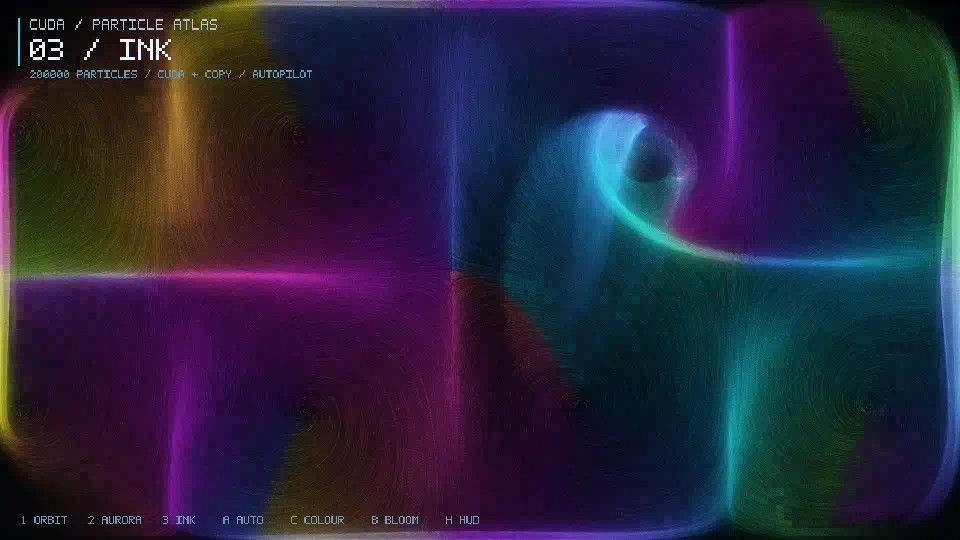
The final project has three scenes. Orbit starts with spiral arms and differential rotation. Aurora carries coloured bands through a moving field. Ink uses a curl field to form rolling eddies. Moving the cursor stirs the particles; the mouse buttons attract or repel them.
These are art-directed fields. They borrow visual ideas from galaxies, auroras and ink without trying to be a gravity or fluid solver.
Keeping the work on the GPU
In the default path, CUDA writes particle positions and colours directly into OpenGL vertex buffers. Rendering adds the particles to a persistent HDR framebuffer, then applies bloom and tone mapping. The trails are part of that framebuffer's history, so pausing also freezes the accumulated light.
Hybrid-GPU laptops can put CUDA and OpenGL on different devices. I kept an explicit fallback that copies particle data through the CPU, with a label in the interface so the slower path is visible. The supplied recording uses that fallback.
The learning examples stay small enough to inspect, while the final project adds GPU regression checks and render smoke tests. The next question is how the cost changes when particles start interacting with one another, as they do in my starling-flock simulation.