Work / Seven driver-assistance exercises, from lane detection to an integrated dashcam demo, implemented in Rust.ADAS learning projects in Rust
Working through the systems
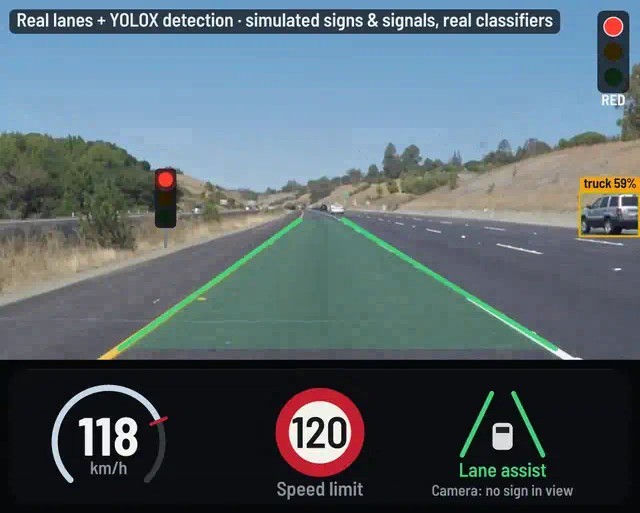
I used a set of ADAS course exercises to explore driver-assistance features in Rust. The workspace builds up from lane detection to sign and speed-limit recognition, object detection, traffic-light detection and an instrument cluster. A final activity runs them together on a dashcam clip.
Inference uses ONNX models through tract, image processing uses Rust libraries, and ffmpeg handles video input and output. The implementation runs without Python or OpenCV.
Handling uncertain detections
The sign classifier can be confidently wrong. The speed-limit tracker therefore waits for agreement across frames and a clear lead over competing readings before changing the displayed limit. Object and traffic-light detections have their own false positives, documented in the repository.
This is a learning project using recorded footage, separate from my production ADAS work. It does not demonstrate a validated driving system. For my experiments with vision-language planning, see EMMA-VLM.